
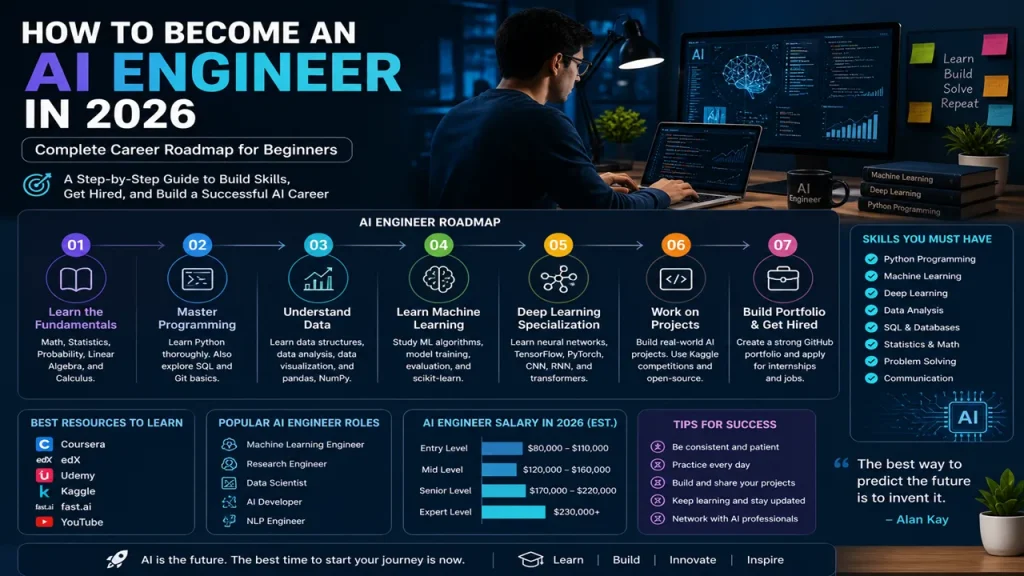
Introduction: Why AI Engineering Is One of the Most Valuable Careers in 2026
Artificial Intelligence is no longer an emerging field—it is one of the most critical pillars of the global economy. In 2026, companies across every industry are actively searching for skilled professionals who can design, build, and deploy AI systems.
The role of an AI engineer has become one of the most in-demand, high-paying, and future-proof careers available today. However, many beginners are overwhelmed by the complexity of the field and unsure where to start.
This comprehensive roadmap provides a structured, step-by-step path to becoming an AI engineer, covering everything from foundational skills to advanced specialization, along with practical strategies for long-term career growth.
What Does an AI Engineer Do?
An AI engineer is responsible for building systems that can simulate human intelligence. These systems are used in applications such as:
- Recommendation engines
- Autonomous systems
- Natural language processing
- Computer vision
Core Responsibilities
- Designing machine learning models
- Processing and analyzing data
- Deploying AI systems into production
- Optimizing performance and scalability
AI Engineer vs Related Roles: Key Differences
| Role | Focus Area | Tools Used | Skill Level |
|---|---|---|---|
| AI Engineer | Building AI systems | TensorFlow, PyTorch | Advanced |
| Data Scientist | Data analysis | Python, R | Intermediate |
| Software Engineer | Application development | Java, Python | Intermediate |
| Machine Learning Engineer | ML pipelines | Scikit-learn | Advanced |
Step-by-Step Roadmap to Become an AI Engineer
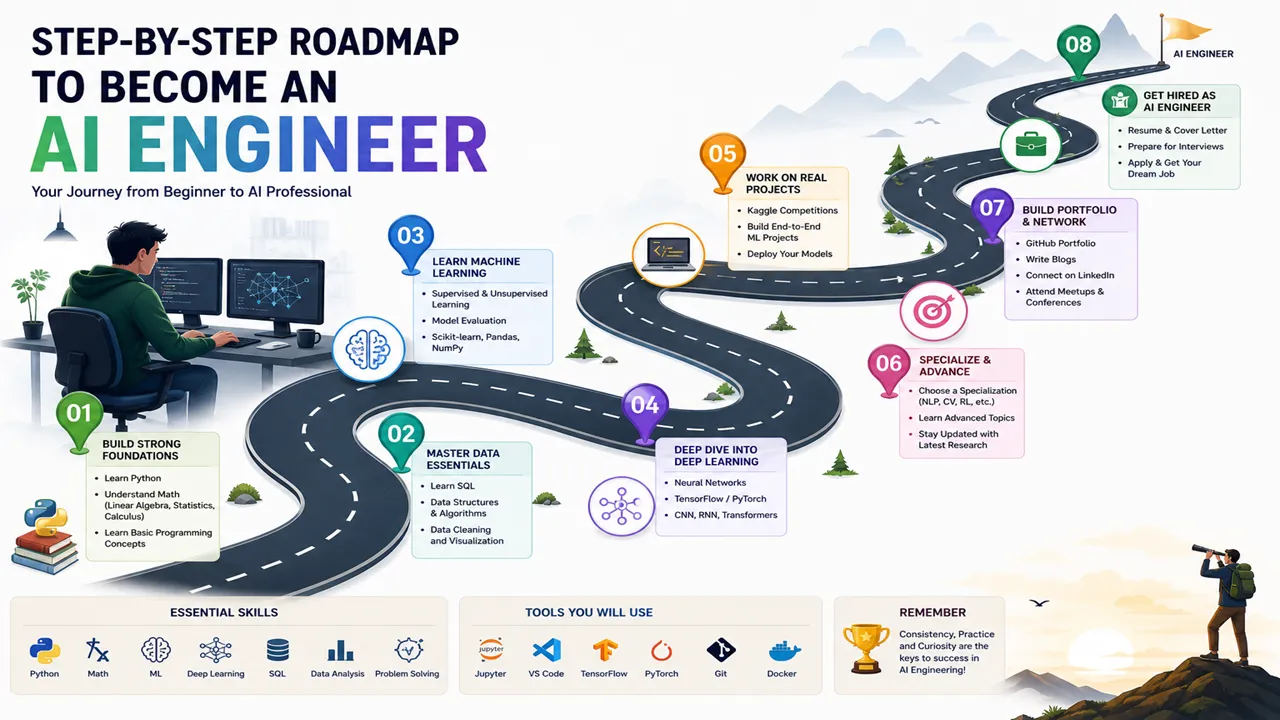
Step 1: Build Strong Foundations
Before learning AI, you need a solid technical base.
Essential Skills
- Mathematics (linear algebra, probability, statistics)
- Programming (Python is the most important)
- Basic computer science concepts
Table: Core Foundations
| Skill Area | Importance | Why It Matters |
|---|---|---|
| Mathematics | High | Required for algorithms |
| Programming | High | Enables implementation |
| Data Handling | Medium | Essential for ML models |
Step 2: Learn Programming for AI
Python is the dominant language in AI.
Key Libraries
- NumPy
- Pandas
- Matplotlib
Comparison: Python vs Other Languages
| Language | Use in AI | Difficulty | Popularity |
|---|---|---|---|
| Python | High | Beginner-friendly | Very high |
| R | Medium | Moderate | Medium |
| Java | Low | Advanced | Medium |
Step 3: Understand Machine Learning
Machine learning is the core of AI.
Key Concepts
- Supervised learning
- Unsupervised learning
- Model evaluation
Table: Types of Machine Learning
| Type | Description | Example |
|---|---|---|
| Supervised | Labeled data | Spam detection |
| Unsupervised | Unlabeled data | Customer segmentation |
| Reinforcement | Reward-based learning | Game AI |
Step 4: Learn Deep Learning
Deep learning enables advanced AI systems.
Topics to Cover
- Neural networks
- Convolutional neural networks
- Transformers
Comparison: Machine Learning vs Deep Learning
| Feature | Machine Learning | Deep Learning |
|---|---|---|
| Complexity | Moderate | High |
| Data Requirement | Medium | High |
| Performance | Good | Excellent |
Step 5: Work with AI Frameworks
To become an AI engineer, you must master tools used in the industry.
Popular Frameworks
- TensorFlow
- PyTorch
Table: Framework Comparison
| Framework | Strength | Use Case |
|---|---|---|
| TensorFlow | Scalable | Production systems |
| PyTorch | Flexible | Research and prototyping |
Step 6: Build Real-World Projects
Projects are essential for demonstrating skills.
Example Projects
- Recommendation system
- Image classifier
- Chatbot
Table: Beginner vs Advanced Projects
| Level | Project Type | Complexity |
|---|---|---|
| Beginner | Data analysis | Low |
| Intermediate | ML model | Medium |
| Advanced | AI system | High |
Step 7: Learn Data Engineering Basics
AI engineers must handle data efficiently.
Skills Required
- Data pipelines
- Databases
- Data preprocessing
Step 8: Understand Deployment and MLOps
Building models is not enough—you must deploy them.
Key Concepts
- Model deployment
- Cloud platforms
- Continuous integration
Comparison: Development vs Deployment
| Stage | Focus | Tools |
|---|---|---|
| Development | Model building | Python |
| Deployment | Production | AWS, Docker |
Step 9: Choose a Specialization
AI is a broad field. Specializing increases your value.
Popular Specializations
- Natural Language Processing
- Computer Vision
- Robotics
- Generative AI
Table: Specialization Comparison
| Field | Use Case | Demand |
|---|---|---|
| NLP | Chatbots | High |
| Computer Vision | Image recognition | High |
| Robotics | Automation | Medium |
Step 10: Build a Portfolio and Gain Experience
Employers value practical experience.
Portfolio Tips
- Publish projects on GitHub
- Write technical blog posts
- Contribute to open-source projects
Skills Required to Become an AI Engineer
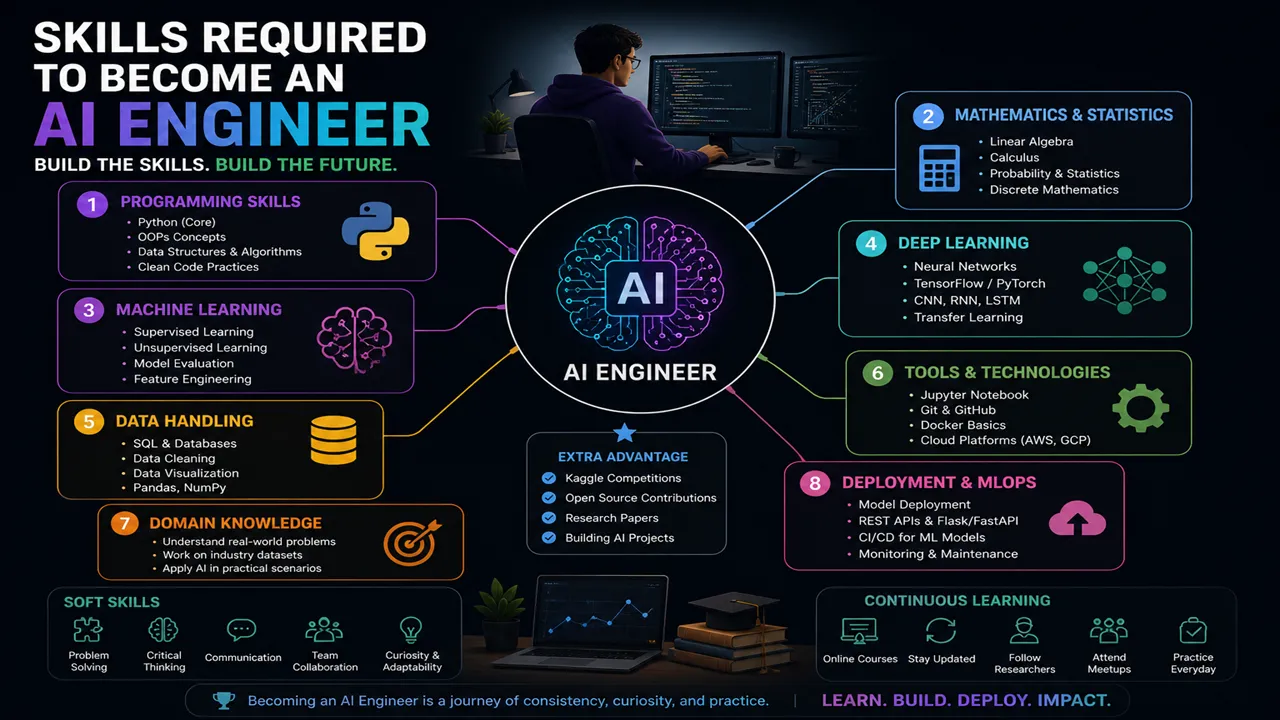
Technical Skills
- Python programming
- Machine learning algorithms
- Data processing
Soft Skills
- Problem-solving
- Analytical thinking
- Communication
Salary Expectations in 2026
| Experience Level | Average Salary |
|---|---|
| Entry-level | $70,000 – $100,000 |
| Mid-level | $100,000 – $150,000 |
| Senior | $150,000 – $250,000 |
Career Path: AI Engineer Growth Timeline
| Stage | Duration | Focus |
|---|---|---|
| Beginner | 0–6 months | Fundamentals |
| Intermediate | 6–12 months | ML and projects |
| Advanced | 1–2 years | Specialization |
Challenges Beginners Face
- Information overload
- Lack of structured learning
- Difficulty in building projects
Comparison: Self-Taught vs Formal Education
| Aspect | Self-Taught | Formal Degree |
|---|---|---|
| Cost | Low | High |
| Flexibility | High | Low |
| Structure | Low | High |
| Industry Recognition | Medium | High |
Future of AI Engineering Careers
AI engineers will play a central role in:
- Automation systems
- Smart infrastructure
- Advanced analytics
SEO Strategy for This Topic
Target Keywords
- how to become AI engineer
- AI engineer roadmap
- AI career guide
Optimization Tips
- Use structured headings
- Include tables and comparisons
- Provide actionable steps
FAQ: Becoming an AI Engineer
Becoming an AI engineer typically takes 1–2 years of consistent learning and hands-on practice. The timeline depends on your background, learning speed, and the amount of real-world projects you build along the way.
AI engineering can be challenging because it involves programming, mathematics, machine learning, and problem-solving. However, with structured learning, practical projects, and consistency, it is achievable for most motivated learners.
No, a university degree is not always necessary to become an AI engineer. Many companies value practical skills, certifications, GitHub portfolios, and real-world AI projects more than formal education alone.
Final Thoughts
Becoming an AI engineer in 2026 is one of the most strategic career decisions you can make. With the right roadmap, consistent effort, and practical experience, you can enter one of the most rewarding fields in technology.
The key is to focus on fundamentals, build real-world projects, and continuously improve your skills.

Comments are closed.