Meta Title: Build Strong Foundations Before Learning AI: Essential Skills for Success
Meta Description: Discover the core skills you need before learning artificial intelligence, including mathematics, programming, and computer science fundamentals. Build a strong AI foundation today.
article content titles
ToggleBuild Strong Foundations Before Learning AI
Artificial Intelligence (AI) is transforming industries, creating new career opportunities, and reshaping the future of technology. From self-driving cars to advanced language models, AI is everywhere. However, many beginners make the mistake of jumping directly into machine learning frameworks and AI tools without first developing the necessary foundational skills.
The truth is simple: before learning AI, you need a solid technical base. Strong foundations make advanced concepts easier to understand, help you solve problems effectively, and accelerate your growth as an AI professional.
In this guide, you’ll learn the essential skills required before diving into artificial intelligence and why these skills matter in your long-term success.
Why Foundations Matter in AI
Many newcomers are attracted to AI because of exciting applications such as ChatGPT, image generation, robotics, and predictive analytics. While modern tools make AI more accessible than ever, understanding how these systems work requires knowledge beyond clicking buttons or running code.
Without foundational skills, you may encounter challenges such as:
- Difficulty understanding algorithms
- Inability to troubleshoot model errors
- Limited capacity to optimize performance
- Challenges interpreting AI results
- Reduced career growth opportunities
Building a strong foundation creates confidence and prepares you for more advanced topics like machine learning, deep learning, natural language processing, and computer vision.
Core Foundations for Learning AI
The following areas form the backbone of artificial intelligence education.
| Skill Area | Importance | Why It Matters |
|---|---|---|
| Mathematics | High | Required for algorithms |
| Programming | High | Enables implementation |
| Data Handling | Medium | Essential for ML models |
Let’s explore each one in detail.
Mathematics: The Language of AI
Mathematics is often considered the most intimidating part of artificial intelligence. However, you don’t need a PhD to start learning AI. Instead, focus on the mathematical concepts that power machine learning algorithms.
Linear Algebra
Linear algebra forms the foundation of modern AI systems.
Key concepts include:
- Vectors
- Matrices
- Matrix multiplication
- Eigenvalues
- Eigenvectors
- Vector spaces
Why is linear algebra important?
AI models process enormous amounts of data represented as matrices and vectors. Neural networks rely heavily on matrix operations to make predictions and learn patterns.
Real-World Example
When a neural network analyzes an image, every pixel becomes part of a mathematical matrix. The model performs matrix operations thousands of times to identify objects accurately.
Probability
AI systems make predictions based on probabilities rather than absolute certainty.
Important probability topics include:
- Conditional probability
- Bayes’ theorem
- Random variables
- Probability distributions
- Expected values
Probability helps AI models estimate uncertainty and make intelligent decisions based on available information.
Example
Email spam filters use probabilistic models to determine whether an incoming email is spam or legitimate.
Statistics
Statistics enables AI professionals to understand data and evaluate model performance.
Core statistical concepts include:
- Mean
- Median
- Mode
- Variance
- Standard deviation
- Hypothesis testing
- Correlation
- Regression
Statistics helps answer important questions such as:
- Is a model accurate?
- Is a pattern meaningful?
- Is the dataset biased?
Without statistics, interpreting AI outputs becomes difficult.
Recommended Mathematics Learning Path
For beginners:
- Basic algebra review
- Linear algebra fundamentals
- Introductory probability
- Applied statistics
- Calculus basics (optional but useful)
Focus on understanding concepts rather than memorizing formulas.
Programming: Turning Ideas Into AI Solutions
Mathematics provides theory, but programming transforms theory into working applications.
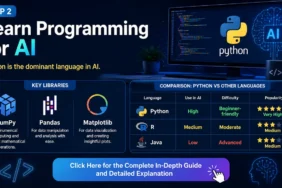
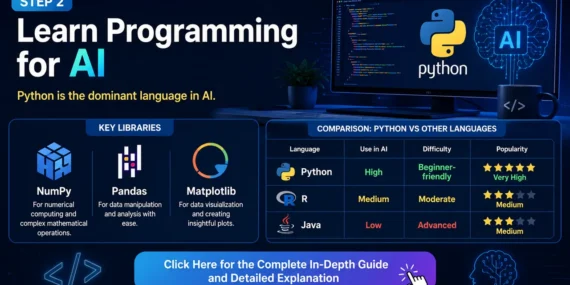
Among all programming languages, Python is the most important for AI development.
Why Python Dominates AI
Python has become the industry standard because it is:
- Easy to learn
- Readable
- Flexible
- Supported by a massive community
- Rich in AI libraries
Popular AI libraries include:
- NumPy
- Pandas
- Scikit-learn
- TensorFlow
- PyTorch
- Matplotlib
These tools allow developers to build sophisticated AI systems efficiently.
Essential Python Skills
Before learning machine learning frameworks, master the basics.
Variables and Data Types
Understand:
- Strings
- Integers
- Floats
- Booleans
Example:
name = "AI Student"
age = 25
Control Structures
Learn how programs make decisions.
Examples:
- if statements
- loops
- conditionals
These concepts appear throughout AI projects.
Functions
Functions help organize code into reusable components.
Example:
def greet():
    print("Welcome to AI")
Well-structured code improves maintainability and readability.
Data Structures
Key Python data structures include:
- Lists
- Tuples
- Dictionaries
- Sets
These structures are critical for storing and processing datasets.
Object-Oriented Programming
Many AI frameworks rely on object-oriented programming concepts.
Learn:
- Classes
- Objects
- Inheritance
- Encapsulation
Understanding OOP makes advanced frameworks easier to use.
Computer Science Fundamentals
Many aspiring AI engineers overlook basic computer science concepts. This mistake often creates knowledge gaps later.
A strong understanding of computer science helps you become a better problem solver and developer.
Algorithms
Algorithms are step-by-step procedures for solving problems.
AI itself is built on algorithms.
Important topics include:
- Searching algorithms
- Sorting algorithms
- Graph algorithms
- Optimization techniques
Learning algorithms improves logical thinking and efficiency.
Data Structures
Efficient AI systems depend on effective data organization.
Key structures include:
- Arrays
- Linked lists
- Stacks
- Queues
- Trees
- Hash tables
These concepts appear frequently in software engineering and machine learning.
Computational Thinking
Computational thinking involves:
- Breaking problems into smaller pieces
- Identifying patterns
- Designing logical solutions
This skill is invaluable for AI practitioners.
Software Development Practices
Professional AI projects require more than model building.
Learn:
- Git and GitHub
- Version control
- Debugging
- Testing
- Documentation
These skills make collaboration easier and improve project quality.
Data Handling: The Fuel Behind AI
AI models learn from data. Without quality data, even the most sophisticated algorithms fail.
Understanding data handling is a crucial skill.
Data Collection
Data may come from:
- Databases
- APIs
- Websites
- Sensors
- User interactions
Knowing how to gather data effectively is essential.
Data Cleaning
Raw data often contains:
- Missing values
- Duplicates
- Errors
- Inconsistencies
Cleaning data is often the most time-consuming part of AI projects.
Many professionals spend more time preparing data than building models.
Data Analysis
Before training models, explore your data.
Questions to ask:
- What patterns exist?
- Are there outliers?
- Is the dataset balanced?
- Are there biases?
Exploratory Data Analysis (EDA) helps answer these questions.
Data Visualization
Visualizations reveal patterns that are difficult to identify in raw numbers.
Popular tools include:
- Matplotlib
- Seaborn
- Plotly
Useful visualizations:
- Histograms
- Scatter plots
- Heatmaps
- Bar charts
Effective visualizations improve decision-making and communication.
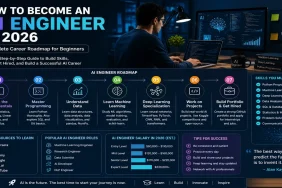
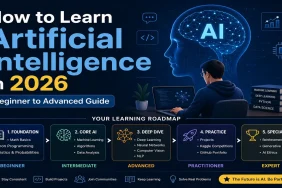
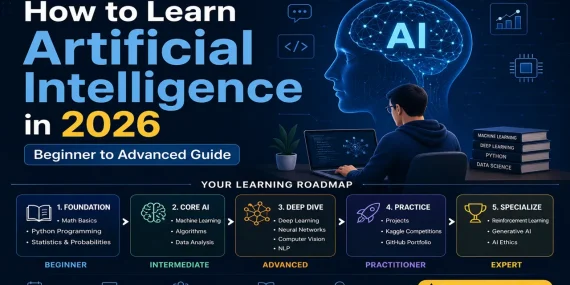
Building a Learning Roadmap for AI
Many beginners ask:
“What should I learn first?”
Here’s a practical roadmap.
Phase 1: Learn Python
Spend 4–8 weeks mastering:
- Syntax
- Functions
- Data structures
- File handling
- Libraries
Goal:
Build simple projects independently.
Phase 2: Study Mathematics
Focus on:
- Linear algebra
- Probability
- Statistics
Goal:
Understand how machine learning algorithms work.
Phase 3: Learn Data Analysis
Master:
- Pandas
- NumPy
- Data visualization
Goal:
Become comfortable working with real datasets.
Phase 4: Learn Computer Science Basics
Study:
- Algorithms
- Data structures
- Git
- Debugging
Goal:
Develop strong problem-solving skills.
Phase 5: Begin Machine Learning
Start learning:
- Supervised learning
- Unsupervised learning
- Model evaluation
- Feature engineering
Goal:
Build your first machine learning projects.
Common Mistakes Beginners Make
Avoid these frequent errors.
Skipping Mathematics
Many learners attempt to avoid math entirely.
While modern tools automate calculations, understanding concepts remains essential.
Learning Too Many Tools at Once
Focus on fundamentals before exploring dozens of frameworks.
Master:
- Python
- Mathematics
- Data analysis
Then expand.
Copying Without Understanding
Tutorials are helpful, but blindly copying code limits growth.
Always ask:
- Why does this work?
- What problem does it solve?
- How can I modify it?
Ignoring Projects
Theory alone is insufficient.
Build:
- Prediction models
- Data dashboards
- Recommendation systems
- AI-powered applications
Projects accelerate learning.
Career Benefits of Strong AI Foundations
Strong fundamentals provide long-term advantages.
Benefits include:
Faster Learning
Advanced topics become easier to understand.
Better Problem Solving
You can debug and improve models effectively.
Greater Flexibility
Strong foundations make it easier to learn new frameworks and technologies.
Higher Employability
Employers value candidates who understand principles, not just tools.
Long-Term Growth
Technology evolves rapidly.
Fundamental knowledge remains valuable regardless of changing trends.
The Future of AI Belongs to Builders
The AI industry is growing at an unprecedented pace. New tools appear every month, but successful professionals share one common trait:
They build strong foundations before pursuing advanced technologies.
Mathematics teaches you how AI thinks.
Programming teaches you how AI works.
Computer science teaches you how systems operate.
Data handling teaches you how AI learns.
Master these fundamentals first, and you’ll be prepared to succeed in machine learning, deep learning, generative AI, and whatever innovations emerge next.
Frequently Asked Questions
No. Start with linear algebra, probability, and statistics. Advanced mathematics can be learned later as needed.
Python is the most widely used language in AI and is sufficient for most learning and professional applications.
Most learners can build strong foundations within 3–6 months of consistent study.
Learning basic Python first is often easier because it provides immediate hands-on experience. Then gradually add mathematics.
Absolutely. Many successful AI professionals are self-taught and developed their skills through structured learning and practical projects. Conclusion
Before learning AI, invest time in building strong foundations. Mathematics, programming, computer science concepts, and data handling form the core skills that support every successful AI career.
Instead of rushing into advanced machine learning frameworks, focus on understanding the fundamentals. The stronger your foundation, the easier every future AI concept becomes.
The best time to build your AI foundation is today. Start with Python, strengthen your mathematical thinking, learn how data works, and create projects that turn knowledge into real-world experience. Your future in AI starts with these essential building blocks. 🚀
-
Yazı Boyutunu Ayarla Okuma rahatlığı için seçin
-
Small 100% Dev