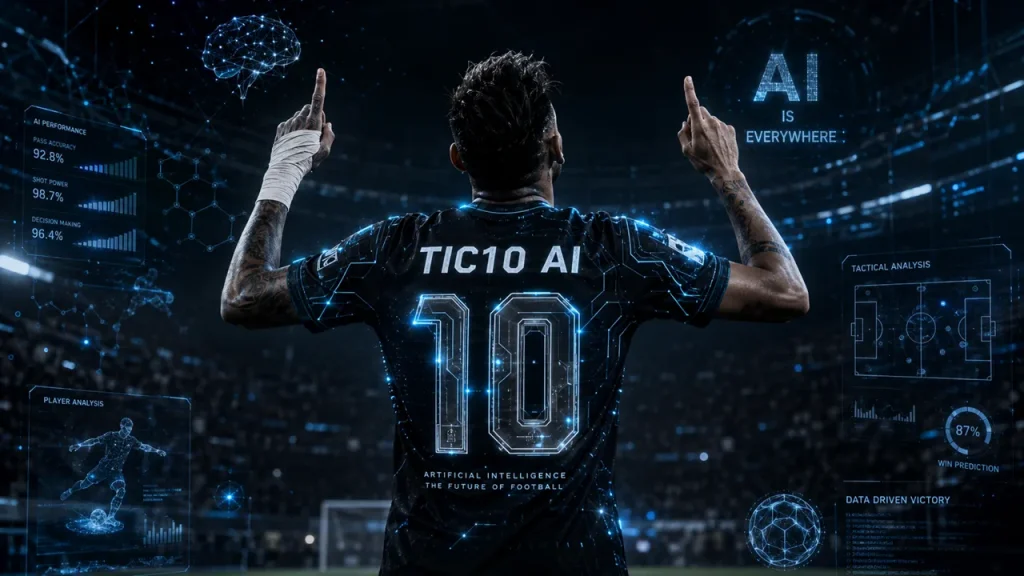
Football used to be easier to explain.
You had talented players, experienced coaches, loud stadiums, and tactical battles that mostly depended on instinct. A manager could spend years building a philosophy based on intuition alone. Scouts traveled from city to city with notebooks in their hands, trying to spot the next great talent before anyone else noticed. Fitness coaches relied heavily on observation, experience, and repetition. In many ways, football survived on human judgment.
That version of the game still exists. But it is no longer the whole story.
Over the last decade — and especially in recent years — artificial intelligence has quietly moved from the background into the center of modern football. Not in a dramatic science-fiction way, but gradually, almost invisibly. First through analytics departments, then through medical monitoring systems, recruitment software, tactical simulations, and eventually fan experiences themselves.
Today, some of the world’s biggest football clubs operate more like technology companies than traditional sports organizations.
And honestly, once you look behind the scenes, it becomes difficult to ignore how deeply AI is now connected to the sport.
Football Is Becoming a Game of Information
Modern football moves too fast for humans to process everything manually.
A single match produces enormous amounts of information:
- player positioning,
- sprint intensity,
- passing angles,
- defensive spacing,
- recovery speed,
- pressing triggers,
- fatigue patterns,
- transition efficiency.
Years ago, analysts would spend hours rewatching footage to understand these details. Now artificial intelligence systems can process thousands of events in seconds.
That changes everything.
Coaches no longer rely only on “feeling” when making tactical decisions. They can now see patterns that were almost impossible to detect consistently before. Maybe a team struggles when defending diagonal overloads late in matches. Maybe a midfielder loses positional discipline under aggressive pressing. Maybe an opponent leaves dangerous spaces between fullback and center-back during transitions.
AI systems identify these patterns quickly — sometimes immediately.
And the important thing is this: football at the highest level is often decided by very small margins. A few meters of positioning. A delayed defensive reaction. One poorly timed sprint. When technology helps clubs recognize those details faster than competitors, the advantage becomes very real.
That’s why elite teams are investing so aggressively in analytics departments.
Not because data replaces football knowledge.
Because data sharpens it.
The Role of AI in Tactical Analysis
One of the biggest transformations is happening in tactical preparation.
Managers today prepare for matches with a level of detail that would have seemed excessive twenty years ago. Artificial intelligence tools now simulate attacking structures, defensive transitions, pressing systems, and positional rotations with incredible precision.
A coaching staff can study:
- how opponents build from the back,
- where pressing traps appear,
- which passing lanes open under pressure,
- how players behave in certain tactical scenarios.
What makes AI valuable here is not just speed. It is pattern recognition.
Humans are naturally selective. We notice obvious moments. Machines do not get distracted in the same way. AI systems process huge amounts of information consistently, and that allows them to uncover tactical tendencies many analysts might miss entirely.
Sometimes the smallest observation changes an entire game plan.
A coach might discover that an opponent becomes vulnerable when forced into wide defensive rotations. Another team may realize their press collapses after repeated vertical switches. These are details that can influence match preparation at the highest level.
And increasingly, those insights come from machine learning systems rather than traditional observation alone.
Recruitment Is No Longer Based Only on Reputation
Scouting has probably changed more than most fans realize.
Traditional scouting still matters. Human judgment will always matter. But recruitment departments today combine observation with predictive data models capable of analyzing thousands of players simultaneously.
That changes the economics of football dramatically.
A club no longer needs to depend entirely on expensive global scouting networks to identify emerging talent. AI-powered systems can filter massive databases and highlight players based on:
- tactical fit,
- decision-making quality,
- movement efficiency,
- passing progression,
- defensive reliability,
- physical consistency.
This allows clubs to identify undervalued players much earlier.
And in modern football, timing matters almost as much as talent. The difference between signing a player before the market notices him and after everyone notices him can easily reach tens of millions of dollars.
Artificial intelligence helps reduce that uncertainty.
More importantly, clubs are no longer evaluating players only by raw statistics. Modern systems attempt to predict future performance:
- Can this player adapt to a more intense league?
- Does his playing style match the manager’s tactical structure?
- Is his recent performance sustainable?
- How likely is injury regression?
These are difficult questions even experienced scouts struggle with sometimes. AI does not answer them perfectly — football is still unpredictable — but it improves the quality of decision-making.
That alone is incredibly valuable in an industry where transfer mistakes can define entire seasons.
Injury Prevention Has Quietly Become One of AI’s Biggest Jobs
Football schedules are more demanding than ever.
Top players now compete across domestic leagues, international tournaments, continental competitions, and commercial tours with very little recovery time. Physically, the sport has become relentless.
That is one reason injury prevention has become such an important area for AI development.
Modern wearable technologies constantly collect physical data during training and matches:
- acceleration,
- sprint load,
- muscle fatigue,
- heart activity,
- recovery metrics,
- movement intensity.
Artificial intelligence systems analyze this information continuously.
The goal is not simply to measure performance. The goal is prediction.
If a player’s fatigue indicators begin trending abnormally, medical teams can adjust workload before a serious injury happens. If recovery patterns decline repeatedly, training intensity may be reduced. In some cases, clubs identify injury risks days before players feel obvious symptoms themselves.
This predictive approach is becoming central to elite sports science.
And honestly, it makes sense.
In modern football, keeping players healthy is not just medical management anymore. It is competitive strategy.
VAR Changed More Than Offside Decisions
Few topics divide football fans like VAR.
Some people believe technology improves fairness. Others argue it damages the emotional rhythm of the sport. Both perspectives are understandable.
But regardless of opinion, AI-assisted officiating is expanding.
Semi-automated offside systems already process player positions with extraordinary precision. Goal-line technologies calculate millimeter-level accuracy almost instantly. AI-supported systems continue improving foul recognition and positional tracking.
The larger conversation here is not really about technology itself.
It is about identity.
Football has always contained human error — referees included. That imperfection became part of the sport’s emotional culture. Now the game is trying to balance emotional authenticity with technological precision.
And there is no simple answer.
What seems clear, though, is that football will continue integrating more AI-assisted officiating over time rather than less.
The debate now is about where the limits should be.
AI Is Also Changing the Fan Experience
Most supporters interact with artificial intelligence every day without noticing it.
Streaming platforms use recommendation algorithms to personalize football content. Social media platforms decide which highlights become viral. Video feeds, notifications, clips, commentary recommendations — all increasingly shaped by machine learning systems.
Even how fans consume football is becoming personalized.
Someone who watches tactical analysis videos may receive completely different recommendations than someone focused on transfer news or short-form highlights. Platforms study viewer behavior constantly to maximize engagement.
This affects football culture more than many people realize.
AI does not just influence what fans watch. It influences what conversations become popular, which players trend online, and how narratives spread globally.
In a strange way, football’s digital identity is now partially controlled by algorithms.
Football Video Games Reflect the Same Evolution
You can also see this shift clearly in football gaming.
Modern titles like EA Sports FC 26 and eFootball use increasingly advanced AI systems to create more realistic match behavior.
Player movement feels more intelligent. Defensive structures react dynamically. Tactical systems adapt during gameplay rather than remaining static.
Developers are investing heavily in AI because realism has become one of the most important expectations in sports gaming.
Interestingly, football games and real football analytics are becoming more connected conceptually. Both rely heavily on movement modeling, tactical simulation, and predictive behavior systems.
The line between simulation and analysis continues getting thinner.
The Fear That Football Could Lose Something Human
For all the advantages AI brings, there is also a legitimate concern underneath the excitement.
Many fans worry football could eventually become too calculated.
Too optimized.
Too data-driven.
Too controlled.
Part of football’s magic has always come from unpredictability. Emotional chaos. Irrational moments. Human mistakes. Sudden inspiration.
No algorithm can fully recreate that.
And honestly, maybe it shouldn’t.
There is a risk that excessive dependence on analytics could slowly reduce creativity in certain areas of the game. When every decision becomes optimized around probabilities and efficiency, football can sometimes feel less spontaneous.
That tension probably will not disappear anytime soon.
The future of football may depend on how successfully the sport balances technology with emotion.
Because football without intelligence becomes outdated.
But football without emotion stops feeling like football.
Clubs That Ignore AI May Fall Behind
Whether people love or hate the technological direction of football, one reality is becoming difficult to deny:
Artificial intelligence is no longer optional at the highest level.
Elite organizations such as:
- Manchester City
- Liverpool FC
- Real Madrid CF
- FC Bayern Munich
have invested heavily in analytics, sports science, performance technology, and recruitment infrastructure.
That investment is not happening accidentally.
Modern football is becoming a competition not only between players and managers, but between information systems.
The clubs capable of understanding data fastest — and applying it intelligently — gain meaningful advantages over time.
And in elite sport, even small advantages compound quickly.
The Future Is Probably Closer Than Most People Think
Artificial intelligence in football is still developing.
What exists today may eventually look primitive compared to what arrives over the next decade:
- advanced tactical assistants,
- predictive injury forecasting,
- AI-supported referee systems,
- virtual reality training environments,
- fully automated analytical platforms,
- deeper fan personalization experiences.
Some experts even believe clubs may eventually use AI to support broader strategic operations beyond performance itself.
But despite all these possibilities, football will probably never become fully automated.
At its core, the sport still belongs to people.
The stadium atmosphere.
The pressure.
The emotion after a late goal.
The unpredictability of knockout football.
The irrational decisions that somehow change history.
Artificial intelligence can analyze football.
It can optimize football.
It can reshape football.
But it still cannot fully replace the emotional experience that made billions of people fall in love with the game in the first place.
And maybe that is exactly why this technological evolution feels so fascinating.
Football is changing rapidly.
Yet somehow, underneath all the algorithms and data models, it is still trying to remain human.