Meta Title: Learn Programming for AI: Why Python Dominates Artificial Intelligence
Meta Description: Discover why Python is the leading programming language for AI. Learn essential AI libraries, compare Python with R and Java, and build the programming skills needed for a successful AI career.
Step 2: Learn Programming for AI
Artificial Intelligence is transforming industries, creating new career opportunities, and changing how businesses operate. But before you can build machine learning models, create intelligent applications, or work with advanced AI systems, you need one critical skill:
Programming.
Programming serves as the bridge between AI theory and real-world implementation. While mathematics helps you understand how algorithms work, programming allows you to bring those algorithms to life.
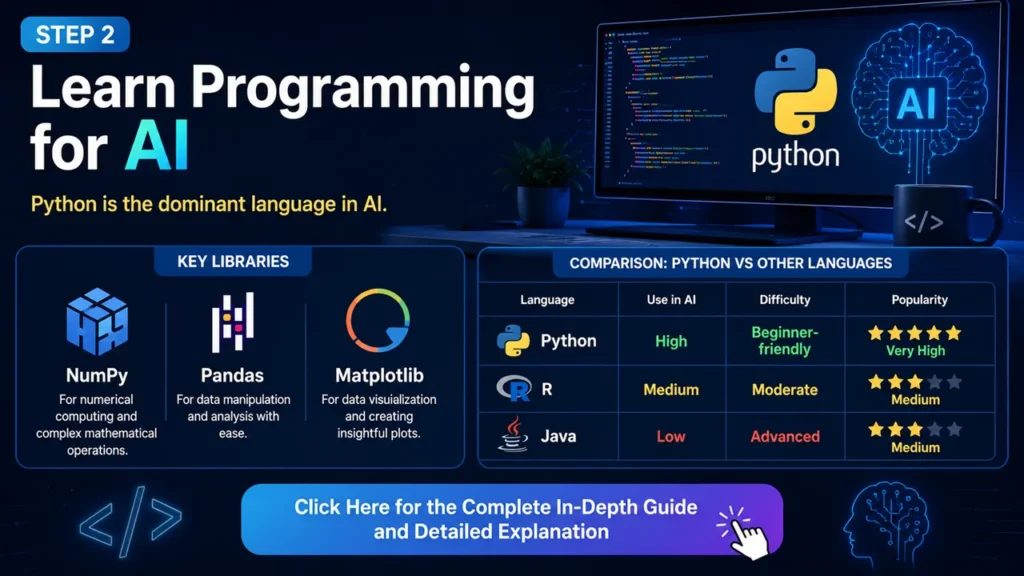
Among all programming languages available today, Python has become the dominant language for AI development. Its simplicity, powerful ecosystem, and extensive community support have made it the first choice for beginners and professionals alike.
If you’re serious about learning artificial intelligence, understanding Python and its ecosystem should be one of your highest priorities.
In this guide, you’ll learn why Python dominates AI, explore the most important AI libraries, compare Python with other languages, and discover how to build a strong programming foundation for a successful AI career.
Why Programming Matters in Artificial Intelligence
Many people become interested in AI because of technologies such as:
- ChatGPT
- Autonomous vehicles
- Recommendation systems
- Computer vision
- Voice assistants
- Generative AI
However, these technologies don’t exist without programming.
Programming enables AI professionals to:
- Process data
- Train machine learning models
- Build neural networks
- Automate workflows
- Create AI-powered applications
- Deploy intelligent systems
Without programming skills, understanding AI remains largely theoretical.
Think of programming as the language you use to communicate with machines.
Why Python Became the Standard for AI
Python wasn’t originally designed specifically for artificial intelligence. Yet over time, it became the industry’s preferred language.
Today, companies ranging from startups to global technology leaders rely heavily on Python for AI development.
Simplicity and Readability
One reason Python became so popular is its clean syntax.
Compare a simple example:
Python:
numbers = [1, 2, 3, 4, 5]
average = sum(numbers) / len(numbers)
print(average)
The code is easy to understand even for beginners.
This simplicity allows developers to focus on solving AI problems instead of struggling with complex programming syntax.
Massive AI Ecosystem
Python offers thousands of libraries specifically designed for data science, machine learning, and artificial intelligence.
Instead of building everything from scratch, developers can use proven tools that save time and improve productivity.
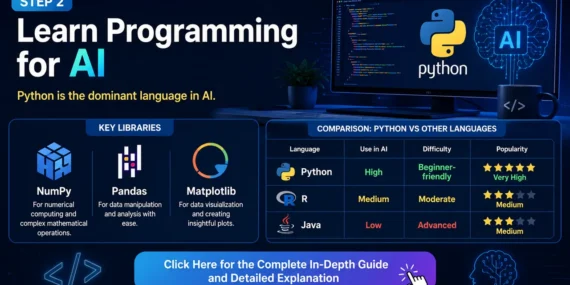
Some of the most important libraries include:
- NumPy
- Pandas
- Matplotlib
- Scikit-learn
- TensorFlow
- PyTorch
These libraries have become industry standards.
Strong Community Support
Python has one of the largest developer communities in the world.
Benefits include:
- Extensive documentation
- Online tutorials
- Open-source projects
- Active forums
- Educational resources
When beginners encounter problems, solutions are usually easy to find.
Cross-Platform Compatibility
Python runs on:
- Windows
- macOS
- Linux
- Cloud environments
This flexibility makes it ideal for AI development across different systems.
Essential Python Libraries for AI
Learning Python alone is not enough.
To work effectively with AI, you must understand several key libraries that form the foundation of modern machine learning workflows.
NumPy: The Foundation of Scientific Computing
NumPy stands for Numerical Python.
It provides powerful tools for:
- Mathematical operations
- Multi-dimensional arrays
- Matrix calculations
- Linear algebra
Since AI algorithms rely heavily on mathematical computations, NumPy plays a crucial role.
Why NumPy Matters
Machine learning models process large amounts of numerical data.
NumPy enables efficient handling of this data while significantly improving performance.
Common NumPy Applications
- Data preprocessing
- Mathematical calculations
- Matrix transformations
- Statistical analysis
Many advanced AI libraries are built directly on top of NumPy.
Pandas: Working with Data Efficiently
Data is the fuel that powers artificial intelligence.
Before training any model, developers must collect, organize, clean, and analyze data.
This is where Pandas becomes essential.
What Pandas Does
Pandas allows developers to:
- Load datasets
- Filter information
- Clean data
- Analyze trends
- Manipulate structured information
It introduces powerful data structures such as:
- Series
- DataFrames
These structures simplify complex data operations.
Real-World Example
Imagine working with customer purchase data.
Using Pandas, you can:
- Remove duplicates
- Handle missing values
- Calculate averages
- Identify patterns
Without Pandas, these tasks would require significantly more code.
Matplotlib: Visualizing Data
Data visualization is one of the most important steps in AI development.
Before building models, you need to understand the data.
Matplotlib helps transform numbers into meaningful visual insights.
Why Visualization Matters
Visualizations help identify:
- Trends
- Outliers
- Relationships
- Distribution patterns
Understanding these characteristics improves model performance.
Popular Visualizations
Matplotlib allows developers to create:
- Line charts
- Bar graphs
- Histograms
- Scatter plots
- Pie charts
These visualizations make data easier to interpret.
Example Use Cases
AI professionals use visualizations to:
- Analyze customer behavior
- Study model accuracy
- Evaluate predictions
- Detect anomalies
Visualization is often the first step toward building better AI systems.
Beyond the Basics: Libraries You’ll Learn Later
As your AI journey progresses, you’ll encounter additional libraries.
Scikit-Learn
Ideal for:
- Machine learning algorithms
- Model evaluation
- Classification
- Regression
Excellent for beginners.
TensorFlow
Created by Google.
Popular for:
- Deep learning
- Neural networks
- Production AI systems
Used by organizations worldwide.
PyTorch
Developed by Meta.
Known for:
- Research applications
- Flexibility
- Deep learning experimentation
Widely used in academia and industry.
Python vs Other Languages for AI
While Python dominates AI, it’s not the only language available.
Let’s compare it with other popular options.
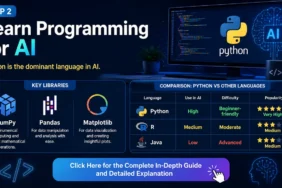
Comparison: Python vs Other Languages
| Language | Use in AI | Difficulty | Popularity |
|---|---|---|---|
| Python | High | Beginner-friendly | Very High |
| R | Medium | Moderate | Medium |
| Java | Low | Advanced | Medium |
Python for AI
Strengths
- Easy to learn
- Massive ecosystem
- Extensive documentation
- Strong community support
- Industry standard
Weaknesses
- Slightly slower than compiled languages
For most AI projects, Python remains the best overall choice.
R for Data Science
R is popular among statisticians and researchers.
Strengths
- Excellent statistical analysis
- Advanced data visualization
- Academic popularity
Weaknesses
- Smaller AI ecosystem
- Less versatile for production systems
R remains valuable for analytics but is less dominant in modern AI development.
Java in Artificial Intelligence
Java has historically been used in enterprise applications.
Strengths
- High performance
- Strong scalability
- Enterprise adoption
Weaknesses
- More complex syntax
- Smaller AI community
- Slower development speed
Java still appears in certain AI environments but is no longer the first choice for most projects.
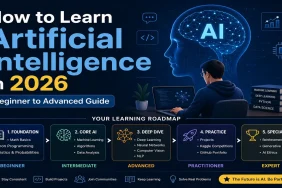
Building Your First AI Programming Roadmap
Many beginners ask:
“What should I learn first?”
Follow this practical sequence.
Month 1: Python Fundamentals
Learn:
- Variables
- Data types
- Loops
- Functions
- Conditionals
Goal:
Write small programs independently.
Month 2: Intermediate Python
Focus on:
- File handling
- Modules
- Classes
- Object-oriented programming
Goal:
Build larger projects.
Month 3: NumPy and Pandas
Learn:
- DataFrames
- Array operations
- Data cleaning
- Data manipulation
Goal:
Analyze real datasets.
Month 4: Data Visualization
Master:
- Matplotlib
- Charts
- Exploratory analysis
Goal:
Understand patterns through visuals.
Month 5: Machine Learning Introduction
Begin learning:
- Scikit-learn
- Model training
- Model evaluation
Goal:
Build your first predictive models.
Common Programming Mistakes AI Beginners Make
Avoiding these mistakes can dramatically accelerate your progress.
Learning Too Many Languages
Some beginners attempt to learn:
- Python
- Java
- C++
- JavaScript
All at the same time.
Focus on Python first.
Master one language before exploring others.
Ignoring Fundamentals
Frameworks are important, but fundamentals matter more.
Understand:
- Variables
- Functions
- Loops
- Data structures
Strong foundations create stronger AI developers.
Copying Tutorials Without Practice
Watching videos is helpful.
Building projects is better.
Create:
- Data analysis projects
- Prediction models
- AI dashboards
- Automation scripts
Practical experience accelerates learning.
Avoiding Debugging
Errors are part of programming.
Every bug teaches valuable lessons.
The best developers become skilled problem solvers because they learn how to debug effectively.
Career Opportunities for Python AI Developers
The demand for AI professionals continues to grow.
Common roles include:
- Machine Learning Engineer
- AI Engineer
- Data Scientist
- Data Analyst
- Deep Learning Specialist
- NLP Engineer
- Computer Vision Engineer
Python skills appear in the majority of AI-related job descriptions.
Learning Python today is an investment in future career opportunities.
Why Python Will Continue Leading AI
Despite emerging technologies, Python remains the dominant language in artificial intelligence.
Reasons include:
- Massive ecosystem
- Constant innovation
- Strong corporate support
- Open-source development
- Educational accessibility
As AI adoption grows, Python’s influence is expected to remain strong for years to come.
Frequently Asked Questions
Conclusion
Programming is one of the most important steps in your artificial intelligence journey. While many languages exist, Python has emerged as the clear leader because of its simplicity, flexibility, and powerful ecosystem.
By learning Python and mastering libraries such as NumPy, Pandas, and Matplotlib, you’ll develop the practical skills needed to work with data, build machine learning models, and create AI-powered solutions.
The future of AI belongs to builders—not just users.
Start with Python, practice consistently, build projects, and strengthen your programming foundation. Every line of code you write brings you one step closer to becoming an AI professional in one of the world’s fastest-growing industries.